by Philip Becker
October 2026
On September 13, the Enfield Shaker Museum and the New Hampshire chapter of the American Guild of Organists (AGO) collaborated to present a recital of organ music in the Mary Keene Chapel on the museum campus. The Enfield Museum tells the story of the thriving Shaker colony that existed in Enfield over one hundred years ago, with artifacts from the period. The AGO has primary interest in the Casavant organ in the chapel since it is in playable condition, and especially since it is in a beautiful building with wonderful acoustics. That being the case, one can hear what an early 20th century organ sounds like, a sound that is still valued along with that of a symphonic organ such as in Methuen, MA. The museum has an interest in seeing the building used as a gathering space since it no longer supports a worshiping community. The Shaker Museum in Enfield is one of two dedicated to the history of the Shakers in the state, the other being in Canterbury, NH.
The chapel and organ were not part of the original Shaker property. Mary Keene was a benefactress of the Catholic Order of the Missionaries of LaSalette. She received a substantial inheritance from her uncle and used it to purchase the Enfield Shaker property and build a chapel for the Order. Her largesse allowed them to establish a seminary, high school and retreat in Enfield. The Order has since departed Enfield, but still operates missions in the United States and abroad. There is no organizational or religious affiliation between the LaSalltes and the Shakers.
Mary Keene left a significant mark on the site and the history of Enfield. What a beautiful mark it is, worthy of the term, “Lush.” The chapel is built with granite walls, covered inside with marble, large stained-glass windows, columns and an altar in classic 19th century Catholic style. The construction of the chapel and the installation of the organ date to about 1930 and the organ is in remarkable playing condition for its age, having escaped rebuilding or restoration.
The program was introduced to a full house of about 150 by Mary Ann Haagan, a resident scholar in the music department at Dartmouth. She is Organ Restoration Project Coordinator. She is actively engaged in the work of the Enfield Shaker Museum. Her research focuses on the N.H. Shaker communities in Enfield and Canterbury. She told of the broad interest in the Mary Keene organ, “The Museum is committed to addressing its needs, and appreciates partnering with others who share a love of pipe organs. For the past three years’ organists, choral groups and instrumental ensembles have generously donated their time and talent to create summer recitals featuring the organ. Proceeds from these concerts and donor interest make it possible for restoration work on this precious instrument to continue. The Enfield Shaker Museum is deeply grateful for all those who support this undertaking with their time, talent, and financial resources.” The door collection today of $1345 will go toward ongoing restoration projects. To date contributions have paid for the complete rebuild of the wind chest that receives and regulates the air pressure produced by the organ’s electric blower. In addition, coupling mechanisms have been repaired that had failed.
Henry Danaher, Director of Music at The Church of Christ at Dartmouth College introduced the program. He spoke briefly about the organ. “The Casavant is simultaneously one of the most aesthetically significant, and vulnerable pipe organs in the state of New Hampshire. Without question, there is an enormous body of organ literature which will sound stylistically correct in our region only on this particular pipe organ. It has held up remarkably given that it has been many decades since an active congregation has occupied the Chapel. Because the project started right before the stock market crash of 1929, its quality is due to a rare accident of history, and it stands as a representative of the Casavant vintage that existed in the early twentieth-century. This pipe organ comprises one of the Upper Valley’s most underrated, unknown cultural artifacts. The door collection today is to be used for the eventual restoration of the Mary Keene Organ.”
Both organizations have an active interest in history and music. The Shakers were far from the dour, hardworking farmers and crafters that they are sometimes though of and have now all but disappeared with only three members left in Maine. Vocal music has always undergirded Shaker life as evidenced by the thousands of songs they created that survive in hundreds of manuscript hymnals. The song, “Simple Gifts” by the Shakers is still well known. NH Public broadcasting did a fill-in piece on the Shakers that prominently featured that song.
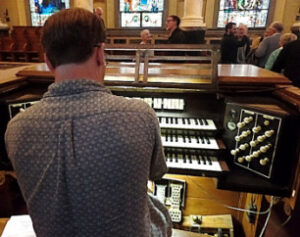
After the program, the organ console was opened for attendies to play. Here, someone from the audience gets to “drive” the Casavant. Exploring the various sounds of an organ is a favorite activity, for all pipe organs are custom designed for purpose and to complement the environment.
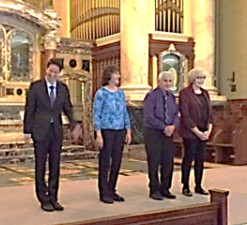
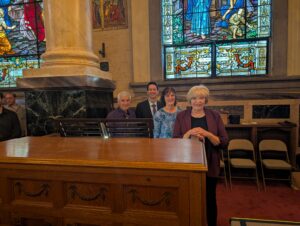
Four organists all played several prepared selections. Mark Polifrone from Marlbrough NH, Mary Ann Fleming from Hancock, NH, Alex Stewart from Newport, NH and Laura Belange from Hill, NH, who plays at Sanborton Congregational Church and is an adjunct faculty at Plymouth State University. They incorporated some of the unusual voiceing of the Mary Keene Organ.
Mark started the program with “Trumpet Tune in D, a lively work featuring the loudest Trumpet on the organ. The Casavant has two trumpets, one that can compete with the best one on the Methuen, MA Great Organ and the other more gentle. Without scientific measurement, one’s ears overload equally at both places. We noticed a missing note on the trumpet part, no fault of the performer, but expected in an almost 100 year old instrument.
Mary Ann followed with an unusual piece: The Bells of St. Anne de Beaupre, whch was composed about the same time the Mary Keene organ started installation. Organs of the 20th century commonly had chimes controlled from the keyboard. They have largly fallen out of favor in newer organs, so it was nice to hear them used in a formal piece of music. The intention of the composer was to musically depict the gathering of the faithful, the chanting of the choir, the procession, the Miracle and the benediction.
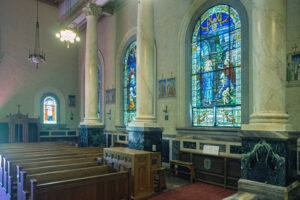
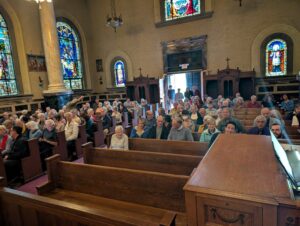
It seemed like a good time to meditate on the beautiful art windows in the Mary Keene chapel. The picture is from the museum’s web site, the view shows the organ console to the right, looking to the rear. It might be easy to confuse the windows with Tiffany glass, but they are German glass. This style of glass art uses ink fired into glass, rather than intricate mosiac. This technique allows more transpaerency for faces and detailed sections.
It was a gray day outside which made the interior somewhat dim. In famous buildings like St. Chapelle in Paris, that makes for a dissapointing look at the curtains of glass, but at the Mary Keene, it made the relatively transparent faces glow with radiance. Maybe it was the miracle of the piece just heard.
The chapel is constructed from thick granite blocks with marble overlay on interior surfaces like the pillar bases. The acoustic effect gives the chapel a warm reberation because thin surfaces do not rellect lower audio frequencies, but thick, dense surfaces do. It is for that reason that the fairly new Meyerson Symphony Center in Dallas, TX. with its McDermott consert hall holding its Fisk Organ, built in Glouscester MA has sound reflecting “clouds” hung from the ceiling. 42 tons of heavy material are used there in order to reflect low frequencies. The sound of the chapel doesn’t change much comparing empty to full house because of its large interior volume. The sound from the organ is noticeably non-directional. One can’t tell if it comes from the front or back.
Today’s third recitalist was Alex who played a piece on the spiritual “Deep River” He used the Casavant’s very rich strings. One of the other recitalists was quoted, “The strings on this organ are substantial enough to float on.”
Laura was the last recitalist and she wowed with Crawford’s Scherzo for Flutes. One notices the lack of articulation for the Doppleflute. It is a characteristic of organs of this vintage.
After final bows, everone was invited to the Shakers’ “Great Stone Dwelling” next door to the chapel for a snack provided by the museum volunteers.
(Photo Credit: Jon Farina)
(Photo Credit: Jon Farina)